

Bitculator Launches 8 API SDKs
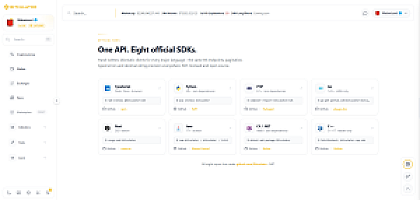
Today we're launching eight official, open-source client libraries for the Bitculator Data API: TypeScript, Python, PHP, Go, Rust, Java, C# and C++. Every one of them covers the full API - all 85 endpoints across 15 resource groups - and every one of them is MIT-licensed and free to use.
If you've ever wired a crypto data feed into a backend, a trading bot, a dashboard or a spreadsheet exporter, you know the boring parts: auth headers, pagination loops, rate-limit retries, error parsing, and the subtle float bugs that creep in when prices cross an eighth decimal. The SDKs exist so you never write that plumbing again.
Hand-written, not generated
These are not machine-generated OpenAPI stubs. Each SDK is hand-written, idiomatic code for its ecosystem:
- Go takes a context.Context first and returns iter.Seq2 range-over-func pagers.
- Rust gives you generic typed responses and a builder-configured client.
- C# is fully async with IAsyncEnumerable auto-paging and CancellationToken support.
- TypeScript uses native fetch, for await pagination and camelCase params with zero dependencies.
- Python is pure stdlib.
- PHP is dependency-free cURL.
- C++ is a single header.
Same surface, native feel. If you switch languages, you already know the SDK.
What every SDK does for you
All eight share the same battle-tested core, so the guarantees are identical everywhere:
- Full coverage - every endpoint in the API reference is one method on one of 15 resource groups: coins, prices, markets, exchanges, wallets, global market, sentiment, indicators, liquidations, conversion, calculators, editorial, alarms, webhooks and meta.
- Decimal-string precision - prices, rates and supplies arrive as strings, never lossy floats. What the market said is what you get.
- Automatic pagination - iterate a Page and the SDK fetches the next pages for you.
- Smart retries - 429s honor Retry-After; transient 5xx and network failures retry only on idempotent calls, so a flaky connection never double-creates an alarm or webhook.
- Typed errors - authentication, permission, validation, rate-limit and server errors are distinct types you can catch, each carrying the API's stable error code.
- Live quota - the X-Quota-* headers from every response are parsed onto the client, so you always know where you stand this month.
Get it from your package manager
Each SDK lives in its own GitHub repository and is published to its native registry:
| Language | Install | Source |
| TypeScript / Node | npm install @bitculator/sdk | bitculator-typescript-sdk |
| Python | pip install bitculator | bitculator-python-sdk |
| PHP | composer require bitculator/sdk | bitculator-php-sdk |
| Go | go get github.com/bitculator/bitculator-go-sdk | bitculator-go-sdk |
| Rust | cargo add bitculator | bitculator-rust-sdk |
| Java | com.bitculator:bitculator (Maven) | bitculator-java-sdk |
| C# / .NET | dotnet add package Bitculator | bitculator-dotnet-sdk |
| C++ | header-only, CMake bitculator::bitculator | bitculator-cpp-sdk |
Logos, install commands and registry links for all eight are also collected on the SDK section of the API page.
Versioned in lockstep with the API
The SDKs follow SemVer and ship in lockstep: when the API gains an endpoint, every SDK gains the method in the same release. The source of truth is the public OpenAPI specification, and the whole surface is documented - with runnable examples in eight programming languages - in the API documentation.
And if you'd rather not install anything at all: you don't need an SDK. The Data API is plain HTTP with a Bearer header - the SDKs just make the pleasant path the default one.
Start building
Read about plans and quotas on the Data API page - there's a free tier, no card required.
Create a key in the developer console and you are ready to get started.
We'd love to see what you build. Issues and pull requests are open on every repository at github.com/bitculator.