

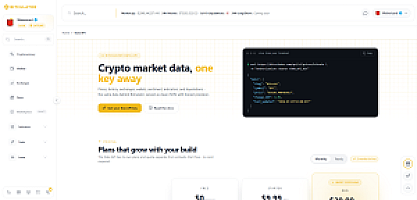
Your first call is one line:
Every chart, table and gauge on Bitculator runs on one data engine: live prices refreshed roughly every minute, thousands of markets across exchanges, sentiment gauges, technical indicators, liquidations, global market history.
Today we're opening that engine up. The Bitculator Data API is live - a Bearer-authenticated JSON API with 85 endpoints across 15 groups, a free tier, and documentation in 19 languages.
Your first call is one line:
curl "https://bitculator.com/api/v1/coins?per_page=5" \ -H “Authorization: Bearer YOUR_API_KEY”
{ "data": [ { "rank": 1, "name": "Bitcoin", "symbol": "BTC", "price": "67412.83451201", "..." : "..." } ], "meta": { "current_page": 1, "per_page": 5, "..." : “...”} }
Create a key in your developer console and that call works right now.
What you can pull
The API is organized into 15 resource groups, and everything the platform shows is in there:
- Coins & prices - the full asset catalog, live quotes, historical prices, OHLC, supply data.
- Markets & exchanges - pairs, tickers, volumes and exchange details across the venues we track.
- Wallets - the wallet directory with specs and supported assets.
- Global market - total market cap, volume and dominance, including historical series.
- Sentiment & indicators - fear & greed, bull/bear regime signals, and technical indicators (RSI, moving averages and friends) per asset.
- Liquidations - long/short liquidation data.
- Conversion & calculators - crypto↔fiat conversion at live rates and the platform's calculator endpoints.
- Editorial - articles and glossary content.
- Alarms & webhooks - create price alarms via the API and receive signed webhook deliveries when they fire.
- Meta - usage, plans and the machine-readable specification.
The full reference, with runnable examples for every endpoint, lives in the API documentation.
Built the way you'd want it built
A few design decisions we refused to compromise on:
- Decimal-string precision. Prices, rates and supplies are returned as strings, never floats. A float can't faithfully carry 0.00000001842, so we don't ask it to. Your parser keeps every digit the market produced.
- One envelope, everywhere. Successful responses are { data, meta }; every error-4xx or 5xx-is { "error": { "code", "message", "details" } }. Match on error.code: messages may be reworded, codes are stable.
- Your quota rides on every response. X-Quota-Limit, X-Quota-Used and X-Quota-Reset headers come back on every call, so you never have to guess where you stand—though you can also just ask GET /usage.
- Predictable limits. per_page caps are plan-based, and exceeding a cap returns an honest 422. The API never silently clamps your request and hands back less than you asked for.
- Signed webhooks. Alarm deliveries carry a Stripe-style X-Bitculator-Signature header so you can verify authenticity before trusting a payload.
- A public spec. The whole surface is described in the OpenAPI specification, and the docs offer a ready-made Postman collection.
Plans that start at free
The Data API has its own monthly quota, separate from Bitculator's embeddable widgets. The free tier needs no card - grab a key and start building. Paid plans raise the monthly call pool and the per_page ceiling; the details and current pricing are on the Data API page.
Don't want to hand-roll HTTP? There's an SDK for that
Alongside the API we ship eight official, MIT-licensed SDKs - TypeScript, Python, PHP, Go, Rust, Java, C# and C++ - each covering all 85 endpoints with automatic pagination, typed errors, smart retries and the decimal-string guarantee built in. Install commands, logos and repository links for all eight are on the SDK section of the API page, and the source is open at github.com/bitculator. But to be clear: you don't need an SDK. It's plain HTTP with a Bearer header - curl, fetch, requests or Guzzle work exactly as you'd expect.
Start building
- Skim the Data API page for plans, quotas and the quickstart.
- Create your key in the developer console
- Make your first call - and check the X-Quota-* headers that come back with it.
We built this API because we wanted it to exist. If you build something on it, we'd genuinely love to hear about it.